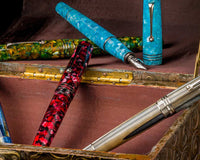

As the snow melts to give way to spring, we turn a new leaf with a new HATCH fountain pen release! Know more about this and what makes it extra special.
Discover the inspiration behind the pen
Let’s get to know the inspiration of HATCH’s latest BENU and @WastedPaper collaboration, the holiDAY DailyMate fountain pen, and learn the meaning behind its splash of bright colors.
Initially, Neil of @WastedPaper was inspired by the meaningful and lively celebration of Independence Day. Then as he was developing the design, his goal evolved to “highlight a holiday that isn’t widely recognized in America using a BENU model that’s equally under-appreciated”.

(Photo taken by Steven Gerner - Flickr: Holi / Festival of Colors 2013 in Utah, United States)
It was how he came to be inspired with the “Festival of Colors” or also known as Holi; a vibrant ancient Hindu festival.
What is Holi?
Holi is a sacred tradition and holiday occurring on the last full moon day of the lunar month. Typically occurring in the first week of March, it symbolizes the beginning of spring, love and new life. But more than the fun festivities, it is also a celebration of the triumph of good over evil; righteousness over injustice.
To understand further, we’ll have to know more about the history tied to this occasion.
History and Tradition
Holi is a festival celebrated in many ways and is rooted in ancient Indian mythology honored by Hindus and also traditionally observed by non-Hindus.
It starts with Holika Dahan, which literally translates to “Holika’s Death” or the “Burning of Holi”. It is a prelude, celebrated on the evening before Holi where they light large bonfires to symbolize the destruction of evil. As told in the Hindu scriptures, their god Vishnu had a devotee called Prahlada; the son of a demon king of Asuras called Hiranyakashipu. This devotion angered the king which resulted in cruel punishments however Phrahlada’s devotion never wavered. Finally, his evil aunt, called Holika, tricked Prahlada to be burned on fire but instead, it burned Holika as Prahlada survived unscathed.

(Image retrieved from NDTV on Holika Dahan 2025: The Significance Of The Pre-Holi Bonfire Ritual)
Thus, on this eve, people gather around the flames to sing, dance, and pray; reliving the destruction of evil and the testament of how faith prevails over tyranny. Resounding outside of Indian beliefs, it is a familiar and relatable theme that feels relevant to this day.
Following this transition is the major festivity called Holi. Its legendary significance is linked to Krishna, a god with a skin like the color of a fresh rain cloud or blue sapphire who was in love with the fair skinned goddess Radha. Beyond desperation of their differences in appearance, Krishna finally offered Radha to color his face any color she likes. Radha did as she returned his love and thus they became a couple with their devotion for each other transcending and expressing unconditional love. And so this playful practice of coloring each other’s faces is how Holi came to be.

(Image retrieved from Britanica on Holi: Festival of Colors)
Over succeeding periods of time and influences, other ways of celebrating the festivity came to be such as the:
- “Warrior Holi” or Hola Mohalla in Punjab, where there is a procession where people sprinkle colored powder either dry or mixed in water followed by the main activities that include ways to display physical prowess such as martial arts, horse riding, and more.
- “Holi of Sticks” or Lathmar Holi in Barsana and Nandgaon, where one of the most popular and unique celebrations of Holi is practiced. Based on an age-old tradition, the men protect themselves with a shield as the women playfully hit them with sticks and a riot of colored powders.
- “Holi of Flowers” or Phoolon wali Holi in Vrindavan, that has more of a devotional significance celebrating a gentle yet playful colorful atmosphere as people shower each other with vibrant flower petals.
These are just some of the unique variations of celebrating Holi in India. At the heart of it all, it’s not just about honoring tradition, it also about expressing gratitude, strengthening bonds, and surpassing class, religion, and caste divide. It is only inevitable that the Festival of Colors caught the fascination of the world; with many parts of Asia, the US, and even Europe taking part of this jovial and colorful remembrance.

(Image retrieved from Britanica on Colours for Holi on sale at a market in Mysore)
Cultural Significance
Aside from honoring tradition, it’s a special day to commemorate spiritual beliefs, reconnect with the culture, and bond with the community who share the same values. Holi is also a festival that inspires forgiveness and love.
As the people on the streets of India in every imaginable hue dance and sing to welcome spring, so are people across the world of all faiths who want to participate and celebrate this time of renewal and beginning of new life.

(Image retrieved from National Geographic - Kids on Holi: Festival of Colors)
While this ancient festival continues to evolve, it keeps its essence intact. It is a day of unity in discordant times, a willingness to embrace each other and get past animosity; rejecting darkness, spreading prosperity and goodwill.
See the BENU x Wasted Paper holiDAY DailyMate Pen Set
Embodied by the DailyMate pen model, it features an acrylic resin body with multicolor glitter accents and silver shimmer, capturing the explosive energy of fireworks and the colorful powders of Holi. The translucent grip and finial showcase the pen's playful aesthetic.

This fountain pen ink set also includes a special collection of four 15ml Tono&Lims ink bottles, containing vibrant colors and shimmer. The colors of the festival are bottled and ready for you to take a splash and scribble with.

It’s a wonderful set crafted with quality and intention. It’s everything you need to write with color and inspiration.
Don't miss this new fountain pen and inks collaboration! Know more about this special release when you visit HATCH!
Bibliography
TOI Lifestyle Desk (2026, February 26) 5 amazing ways to experience Holi in Mathura–Vrindavan. Retrieved from http://timesofindia.indiatimes.com/articleshow/128813803.cms#?utm_source=contentofinterest&utm_medium=text&utm_campaign=cppst
Raj, A. (2026, February 25) Holika Dahan 2026: When will Holi be celebrated in USA — Date, rituals, puja timings and celebration details. Retrieved from https://economictimes.indiatimes.com/news/international/us/holika-dahan-2026-when-will-holi-be-celebrated-in-usa-date-rituals-puja-timings-and-celebration-details/articleshow/128785716.cms?from=mdr#google_vignette
Yoon, J. And Kumar, H. (2025, March 13). What to Know About Holi, India’s Most Colorful Tradition. Retrieved from https://www.nytimes.com/article/holi-colors-spring-festival-india.html
Lasky, J. (2024) Holika Dahan. Retrieved from https://www.ebsco.com/research-starters/religion-and-philosophy/holika-dahan
Volunteer Forever Editorial Team (2022, September 10) What is Holi Festival and Why is it Celebrated?. Retrieved from https://www.volunteerforever.com/article_post/what-is-holi-festival-and-why-is-it-celebrated/
By Some Folks at EndlessPens